Is Just Like Amerika!
Sleep on ground. Fight angry pigs. Eat
very special sausage. Tramp across land without vowels. Go east, American
friend, and discover why hordes of weekend hobos, lawmen, cowboys, and Indians
are searching for the Wild and Crazy West in the woods of the Czech Republic.
By Brad Wetzler
Photographed by John Goodman
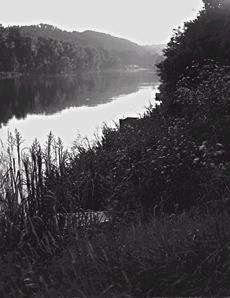
Tramp heaven on the Berounka
River.
IF IT'S TRUE that you are what you eat, then I am a big, greasy
kielbasa. I brought this on myself: For the past week I have been camping with
a dedicated band of carnivores who favor canned meat and an alarming variety of
sausages. We're deep in the Brdy Hills, a rolling patch of beech forest as
charming as a dream, about 30 miles south of Prague in the Czech Republic. The
air is full of the smell of honeysuckle, the buzzing of bees, the chirruping of
bluebirds, and the sizzling of meat. The only human tracks within sight are our
own.
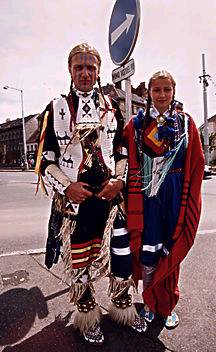
Jiri Kohout and daughter
Nikolka
model the latest faux Lakota
Sioux
finery in Plzen
But this is a curious bunch. There is Jerry, the frequently drunk
prankster who gets his kicks hiding pinecones in our sleeping bags. He whispers
that his real name is Vladimir, but tramps are only supposed to go by their
tramping names. Which is why "Jerry" is tattooed in boldface on his
right forearm. George, a starry-eyed guitar player, can do a rendition of
"This Land Is Your Land" in czech that would make anyone homesick for
the hills of central Bohemia. Ace is a private in the czech army who always
wears a Daniel Boone-style coonskin cap; he sucked down too much rum last night
and, while dancing to George's intoxicating music, fell into the fire. Lucky
for him Sheriff Tom was still sober enough to pull him out. A one-armed bear of
a man, Sheriff Tom is, at 45, the oldest hobo, and he happens to own the
biggest bowie knife, making him the logical choice to be the group's chief
law-enforcement officer.
They are also a slovenly bunch. Empty sausage casings litter our
campsite. Dirty clothes hang from branches. Camping gear-knapsacks, tarps,
cooking kits-is strewn about like leftovers from a yard sale. The tramps
themselves lounge in the dirt, sleeping, smoking, singing songs, telling
stories...and eating meat. So far this week we've feasted on pork, beef, pork-beef
sausage, ham steak, chicken, herring, sardines, smoked oysters, and plain old
grilled meat, a gluey pink mush that comes in a can labeled "Grilled
Meat." It's dinnertime on my fifth day with this group, and I've had
enough-but that's only my opinion. Sheriff Tom insists that I keep up with my
compatriots. He catches me sneaking away from the campfire and blocks my path,
brandishing a bright-red, footlong salami in his one good hand. He's staring
directly into my eyes.
"Very...special...sausage," he says in deliberate, broken,
heavily accented English. "You...will...enjoy...very much."
I ask what's in it. Sheriff Tom casts his gaze skyward, as if scanning
the animal-cracker-shaped clouds to find the poor beast from which this sausage
was rendered. "How you say..." Sheriff Tom says, sounding flustered.
"I don't know. It is big, with hooves. Please. Eat!"
He hands me the sausage and motions for me to try it. Hesitant, I
oblige, biting into the pasty gristle and rolling it around in my mouth. Then I
make myself swallow.
"I know! I know!" Sheriff Tom suddenly blurts out as the
sausage slides down my gullet. "It goes, 'Neighhhhhh!'"
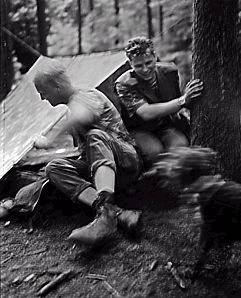
Monkeying around: GI-style
tramps
David Eisenhaner, left, and
Daniel
Knikes prepare for a big meat-eating
offensive behind the Red Monkey Pub.
THE MEN I'M TRAVELING with call themselves the Red Monkey Gang. They're
a proud part of a nationwide movement called tramping, or vandr in Czech. As the name suggests, tramping is a takeoff on
hoboing-the act of drifting from place to place by train or on foot. Real
hoboing had its heyday during the Great Depression in the United States, when
an estimated 1.5 million people lived on the loose. Most came to their vocation
involuntarily, driven to the road by poverty and desperation. Nonetheless,
hobos, like tramps, acquired a reputation for their carefree way of life, their
predilection for booze, and a canon of whimsical folk songs and stories.
The Czech species of tramp, or vandrak,
has the happy-go-lucky, alcohol-soaked aspects of the lifestyle down cold. But
these are not bona fide, full-time tramps. The Czechs are dilettante vagrants:
Recalling the lore of tramping, they embark on excursions in which they merely pretend to be down-and-out wastrels. Nor
do they follow the hobo tradition with any commitment to verisimilitude;
America's wide-open spaces have inspired many Czech "tramps" to dress
up as cowboys or Indians or, just as bizarrely, World War II GIs. On weekends
and during vacations, thousands of them hop trains (paying their fare rather
than stowing away in boxcars), camp out under the stars, or rendezvous in the
hills and at festivals, all the while singing Czech and American folk tunes.
Most are middle-class working men with homes and families, though it's not
uncommon to see women marching into the woods, too. Come Sunday night,
everybody climbs back on the train and goes back to their day jobs.
Sounds like a pretty good life to me. So a few months back I flew to
the Czech Republic and on a balmy Friday afternoon took a cab straight from
Prague's Ruzyne Airport to Smichov Station, aka Tramp Central. There were
tramps everywhere, relaxing on the ground, drinking in the train-station pub,
strumming guitars. I bought a southbound ticket to the central Bohemian village
of Revnice, which, I'd been told, was a jumping-off point for a lot of hobo
outings. I boarded one of the shiny aluminum cars and, imitating the weekend
tramps already on board, slumped on the floor with my backpack.
"Ahoy," the other tramps said to me, using the traditional tramp
greeting. (No one seems to know how ersatz hobos in the landlocked Czech
Republic came to address each other as British sailors.) "Ahoy," I
returned, and each one grasped my hand in the thumb-gripping, soul-style tramp
handshake. We passed around a bottle of rum until Revnice, where I detrained.
Waiting at a bus stop just outside the station was a group of eight men
wearing camouflage: tramps, I surmised. They introduced themselves as the Red
Monkey Gang, welcomed me with handshakes and high-fives, and waved me on board
the bus to Halouny. After five minutes, the bus let us off in a tiny hamlet
consisting of a dozen or so stone houses with red tile roofs.
We shouldered our backpacks and set out up a steep hill in the
direction of some thick green woods. The sun was beginning to set, and I was
concerned that we'd be making camp in the dark. But having spent the better
part of a day in the cramped middle seat of a 747, I relished the exercise and
camaraderie of a group hike. In-country for only a few hours and here I was,
trampin' with tramps!
After about 50 paces, though, Sheriff Tom motioned for me to remove my
pack and pointed at a dilapidated stone building with a leaning front porch in
front and a stinky outhouse in back. This was the Red Monkey Pub-U Cerveneho
Paviana-the terminus, it turned out, of our hike. We entered and drank cold
pilsner until 1 a.m., closing time, after which we set up camp in a small
clearing behind the building. We spread our sleeping bags on the ground, crawled
in, and woke up at noon, just in time for the pub to open.
For the next five days our routine was basic: sleep till 11 or so in
the morning, skulk over to the pub for our noonday beer, pick wild mushrooms
and blueberries, and hike. In the evenings we'd dine on sausage, drink rum,
smoke cigars, and stare into the fire while George serenaded us with Czech
versions of country-and-western songs.
Which brings us up to Saturday night and Sheriff Tom, who's holding me
up with his sausage. I choke the entire thing down under duress while he
watches, and then live with the consequences for the rest of the evening,
sitting in a dyspeptic drowse beneath an incandescent full moon while George
sings "King of the Road," "Hobo Bill's Last Ride,"
"Wabash Cannonball," and "Alaska, I Love You."
I'm still wide awake at 1:10 a.m., lying by the fire in my mummy bag,
listening to Sheriff Tom's semidrunken snoring and trying to calm my aching
stomach, when I hear a scream.
"Kanec!" somebody yells.
It's Jerry the prankster, only now he seems in earnest. He trips over himself,
lunging in my direction. "Kanec!"
he shouts again.
I can hear grunting and heavy breathing, not all of it coming from my
fellow tramps, who are frantically trying to free themselves from their
sleeping bags. Suddenly a squadron of feral pigs crashes through the brush in
single file. One, two, three, four, five. Noses to the ground, they begin to
vacuum the campsite of its rubbish, eating sausage casings, residue in empty
Spam cans, even dirty socks. Their beady eyes, glinting in flashlight beams,
give them the look of crazed beasts from hell, and their razor-sharp tusks
could rip flesh from bone. But then one pauses next to my backpack and I get a
sense of proportion: These pigs are no bigger than Yorkshire terriers.
Indignant, if more than a little relieved, I squirm out of my sleeping bag and
prepare to defend our camp with honor.
Fortunately, I don't have to. The raid lasts less than a minute. Before
anybody gets hurt, the pigs scurry off into the dark-presumably in the
direction of another, even more slovenly, tramp site. The Red Monkeys saunter
back to bed. When I crawl into my bag, a sharp object pricks my thigh and I
grope after it: pinecone. I look over at Jerry, who is sitting up, grinning.
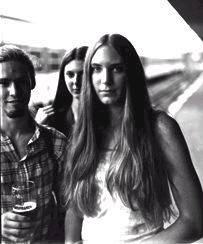
Gypsies, tramps, and
wanna-bes:
Students in Prague gather
at Smichov Station before
heading for the Brdy Hills.
TRAMP. VAGABOND. Vag. Bum. Stew Bum. Profesh. Bindle Stiff. Alki Stiff.
Roadie-Kid. Hobo. The wandering soul
has countless names, many of them suggestive of sloth and indolence. The hobo
(the term possibly a bastardization of a 19th-century vagrant's greeting,
"Ho, beau!") is, one might say, prone to go long stretches without
showering and unapologetic about his heavy smoking and drinking. He rides from
city to city, from job to job-and sometimes he just rides for the peripatetic
hell of it, gathering with fellow tramps in train yards and sleeping under
bridges, outraging the local constabulary. Jack London, who as a youth spent eight
months hoboing in 1894, wrote that the life of the road "entices romantic
and unruly boys, who venture along its dangerous ways in search of fortune or
in a rash attempt to escape parental discipline. It seizes with relentless grip
the unfortunate who drifts with, or struggles against, the tide of human
affairs."
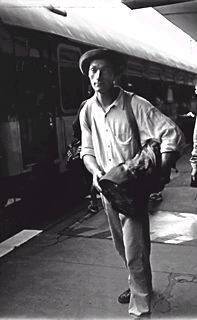
John
Goodman
Even in postwar America, nostalgia and wanderlust kept tramp wanna-bes
hopping boxcars. Nostalgia eventually outweighed wanderlust, though, and
tramping fully evolved into an idiosyncratic pastime, with aficionados in
hobowear gathering like Civil War reenactors to sing the old songs of the road
and swap pork-n-bean recipes. In keeping with the times, those who struggle
against the tide of human affairs now have a support group: the 5,800-member
National Hobo Association, which has a Web site (www.hobo.org), a magazine called The Hobo Times ($25 a year), and annual gatherings. The most recent
conclave was in July in Elko, Nevada, where tramps spread out their bedrolls at
a fairgrounds that, according to hobo.org, offered "electric power,
showers and change rooms, and night lighting."
Unlike the Americans, however, the Czechs never really tramped out of
necessity. From its start in the 1920s, it was a hobby-an amusing
interpretation of American hobos and cowpokes. Marko Cermak, an outdoors writer
and the unofficial historian of tramping in the Czech Republic, says the first
tramps were lone-wolf types who headed for the hills after watching movie
cowboys like Tom Mix and "Bronco Billy" Anderson battle Indians and
herd cattle on the open range. These early Czech tramps would dress like
cowboys, ride the trains to the edge of town, and sleep out under the stars
"cowboy style," as Cermak calls it. It was a time when Europeans were
developing an obsession with all things western through the novels of
turn-of-the-century German writer Karl May, who never set foot in the American
West but wrote of the high mesas and howling coyotes with a Prussian commitment
to authenticity.
Taking a more laid-back approach to the western mania than their
neighbors the Germans, who began organizing cowboy conventions and staging mock
shoot-outs, the Czechs mixed up stories of hobos and cowboys-and-Indians into a
happy stew and called it tramping. Teams of dozens, sometimes hundreds, of
Czech hobos and cowboys established elaborate camps in the hills, where they
elected sheriffs to keep order. (Some camps survive to this day, with cabins
proudly named El Passo [sic], Jack
London, Tacoma, and Cimarron.)
Over time, several factions formed. Some tramps, especially those with
an ecological bent, began imitating the Indians they saw in American movies,
dressing in elaborate costumes, carving totem poles, tanning hides with cow
brains, and erecting tepees. Others specialized in canoe tramping, lugging
their vessels onto trains and riding to their favorite rivers and lakes. After
World War II, American movies inspired yet another vogue, one that is still
prevalent today: the GI tramp. GIs dress in camouflage army fatigues (to blend
in with nature, they say), black army boots, and dog tags.
To make any sense of all this-to form a rational connection between
army-surplus getup, pub-oriented camping, and the Czech version of the
"cowboy life"-you must put yourself in a bohemian frame of mind. The
word "bohemian," with all its boozy, shiftless, rules-be-damned
connotations, was born in this very region of Czechoslovakia-Bohemia, which
comprises half the nation. Gypsies, otherwise known as Roma, or Cikani in Czech, have long been a significant
minority here. (They make up 0.3 percent of the population today.) When Gypsies
trekked beyond Bohemia into France during the 15th century, the French dubbed
them Bohemians, and "gypsy" and "bohemian" became more or
less synonymous. Bohemianism aside, the Czech Republic consumes more beer per
capita than any other nation on earth-almost twice as much as the United
States. This only helps make the country more fertile for tramping. In fact,
the national anthem is fittingly titled "Where Is My Home?"
Even the Nazis and Communists couldn't keep the tramps down. Tramping
groups were active in the underground resistance after Germany invaded
Czechoslovakia in 1939; some who worked in munitions factories employed their
prankster skills in the cause of freedom by mislabeling boxes so that German
troops on the front lines got the wrong-size bullets. When the Reds took over
in 1948, the apparatchiks felt sufficiently threatened by tramps to spy on the
larger camps and break some of them up. Unsupervised assembly was outlawed
which, of course, only made tramping more attractive to the bohemian soul. In
his 1990 book Disturbing the Peace,
Czech president Vaclav Havel recalled the role a group of tramps played when
Russian tanks rolled into a small town north of Prague called Liberec in 1968,
at the end of the Prague Spring. Led by a young man called The Pastor, the
tramps took down all the street signs overnight to confuse the Russians.
Another "poignant scene" involved the group standing guard at the
town hall and singing the Bee Gees hit "Massachusetts." Havel writes:
"I saw the whole thing in a special light, because I still had fresh
memories of crowds of similar young people in the East Village in New York,
singing the same song, but without the tanks in the background."
While disparate tramping groups went on to hold illegal rock concerts
in the seventies and eighties, and in some cases went to jail for their
provocative displays of affection for Western pop culture, tramping didn't face
a real threat to its ethos until shortly after the Velvet Revolution in 1989.
By the time the Czechs and Slovaks had parted ways, in 1992, the Czech Republic
was already knee-deep in its attempts to graft a Western capitalistic head onto
a moribund Eastern Bloc economic body. The transformation worked, for the most
part, but it's had a sullying effect on tramping. Tramps who once scorned
communism began to cast a yearning eye toward Western-style yuppiedom. Though
hordes still tramp, the new economy has inspired careerism among many would-be
hobos.
"Now everybody wants to make money," the bartender at the Red
Monkey Pub told me. "They work long hours and don't have time to spend
their weekends in the woods. They take vacations abroad. I think, too, that
there is nothing to rebel against now." Up until the Velvet Revolution,
she explained, tramps fancied themselves on the outside of society. "Of
course," she said, brightening, "the young tramps, the 17-year-olds,
rebel against capitalism now. So hopefully tramping won't disappear
forever."
One hopes the bartender is right-that democracy, like Nazism and
communism before it, will fail to take the bohemian out of the Bohemians.
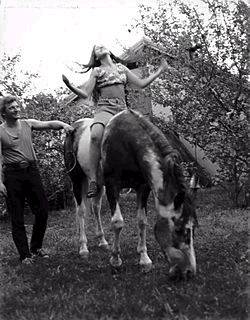
Dyk and his daughter Helena
with Black-and-White in the
backyard.
I'VE GROWN TIRED of the Red Monkey Gang-bless their souls-and their
slothful ways. On the morning of the sixth day, a pack of chipper, clean-cut
tramps marches up to the pub, where we're seated on the front porch, and I
quickly invite myself to join them. But saying good-bye to the boys is not
easy. Sheriff Tom, I'm certain, has never had a more faithful sausage-eating
mate.
"Why no more drink pivo
with us?" he asks, gesticulating with his pilsner. "No like us?"
"Yes. Yes," I say. "I like you."
"No like our sausage?"
Well, now he's getting warmer. I mumble that my bum knee requires
constant movement and move out. The new crew includes a couple of fresh-faced
college students; a lanky young woman; a bony, English-speaking
thirtysomething; and a hirsute middle-aged man. A hundred yards down the trail
I look back-I shouldn't, but I do-and there is the Red Monkey Gang, waving a
forlorn good-bye.
After a few minutes we stop, and the tramps introduce themselves. The
two college kids are called Little Pid and Pad; it's never quite clear what
"Pid" stands for, but "Pad" is Czech slang for "he who
falls down a lot." Rita is Pad's girlfriend. The bilingual guy is the only
one willing to give his real name: Pavel Bem, a talkative psychiatrist who's
also the mayor of one of Prague's 15 boroughs. His nickname, Strevo, translates
as "he who acts withextreme intentions." The leader, a six-foot-two
bruiser with a thick beard, is simply Big Pid.
We grip thumbs, toast one another with the requisite shot of rum, and
set off hiking down a potholed dirt road. Soon the road becomes a single rutted
track in a green tunnel of clattering branches. It's late morning, but the
farther we walk, the darker the woods get. The group plans to hike ten miles to
Kytin, on the eastern slope of the Brdy Hills, and then head for Brdsky Kempy,
"Valley of Brdy Camps," a narrow, heavily wooded canyon that isn't on
any of my maps but, I'm reliably informed, was home to some of the earliest
tramp camps, dating back to the 1920s.
Hiking with this new gang is like competing in a speed-walking contest.
All five are former participants in the Czech scouting movement, and over the
years they've spent a lot of time tramping in the Brdy Hills. Like most,
they've perfected the art of traveling light. Each wears a small, threadbare green
knapsack in which he or she carries a fluffy cotton sleeping bag, a cooking
pot, a spoon, and ingredients for a few meals.
The path meanders between woods and fallow fields where quail and
grouse flutter. According to a historical map of the Brdy Hills, during the
thirties and forties, the most famous group in these parts was the Beer
Volunteer Workers, a pack of about 150 tramps who wandered around dressed like
American cowboys, carrying genuine Colt .45s. Their badge was a Boy Scout
fleur-de-lis with a glass of beer in the center. The gang dwindled during the
fifties, though, due to Communist harassment.
Strevo himself suffered under the regime; he was once jailed for two
days without being told why. "You can't understand unless you've lived
under a totalitarian government," he says. "You begin to question
what the truth is. I think that's why Czechs are very outdoor-oriented. The TVs
and radios constantly played propaganda. We had to get away from it. At least
out here in the woods you could find some truth."
After three hours of hiking we come upon a fire ring nestled beneath a
40-foot rock face and a twisting rivulet. It's one of the early tramp sites.
The wet air drenches my socks and shirt, and giant ferns bow down in the mist.
"We are here," Big Pid says, taking the pack off his back.
We set our things down and begin gathering logs for a fire. I help the
group string a tarp between two trees in case of rain and then unsheath my
nylon tent. I hardly have the first stake in the ground before Big Pid motions
for me to stop. "There are no tents in tramping," he lectures,
shaking his black beard. "You must see the stars." This didn't come
up with the Red Monkeys, but then, I was never sober enough to try to put up a
tent. I slide it back in its sleeve, but Big Pid isn't done yet. "And
there are no gas stoves, fancy backpacks, and none of those PowerBars." He
glares at my carbo stash. "We will show you real tramping food."
I thought I'd already seen real tramping food. Since we got to the
campsite, we've been eating sausage and washing it down with rum. But sausage
is just an appetizer for this crew. As Big Pid speaks, I watch him pull an
entire roasted chicken out of his backpack, followed by an assortment of
vegetables. He dismembers the bird and mixes up a stew over the open fire. The
other tramps prepare meals in their own pots-everything from noodles to chicken
casserole. Then, one at a time, each pot is set in the middle of the campsite.
We stand in a circle and take turns bending down and spooning out a bite. For
about an hour, the six of us share dinner and compliment the chefs. The
evening's entertainment is a traditional tramping game: Standing nose to nose,
we try to knock each other off balance. Big Pid, naturally, goes undefeated.
Then we sprawl on the ground, light cigars, and pass a flask. As the fire dies
down, a cuckoo fills the forest with its unmistakable call. Cuckoo. Cuckoo. Cuckoo. Cuckoo. Cuckoo. Five
cuckoos. "Bad news," Strevo says. "According to the cuckoo bird
you have only five years left to live."
That's not very heartening, I say.
"If it's any consolation," he replies cheerfully, "we
only have five years, too."
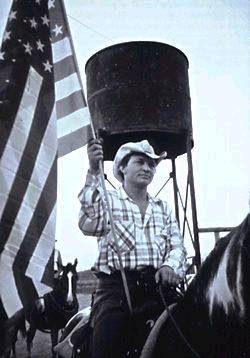
Show your colors:
Dyk puts his game face on
for the calf-roping contest
at Westec City.
"WHAT? DO I LOOK like I was in the Party?" exclaims a thin
man dressed in beads and buckskin, with blue streaks of war paint on his face.
His name is Jiri Kohout. I seem to have offended him by asking whether he'd
been a Communist.
My search for tramps has taken a side trip into terra incognita. I have rented a minivan and, accompanied by my
19-year-old translator, Hana Kozakova, have driven to the small city of Plzen,
about 60 miles west of Prague, in search of the more settled,
rendezvous-oriented, cowboy-and-Indian side of tramping. A rodeo is taking
place here, and I've been told I might find Indians. A good tip, as it turns
out: Within five minutes I bump into Jiri and his tribe next to the funnel cake
booth. His wife, Gabriela, son, Jarda, and daughter, Nikolka, are dressed up
like Lakota Sioux. I ask if he would be so kind as to take me back to his tepee
for a short powwow, and we walk down a sidewalk to a small patch of grass
outside the rodeo arena. There, next to his car with bumper stickers that read
"I Like American Indian PowWows" and "American Indian
Hobbyist," are two tepees, outfitted with colorful blankets and
animal-skin rugs.
The Kohouts are here at the rodeo to perform a prayer dance at
halftime. It would be nice if they did a stop-the-rain dance. It's pouring,
putting a damper on the rodeo. A few moments ago a Czech cowboy slipped in the
muck and was gored by a bull. He's not badly injured, but the ambulance siren
is ruining any sense of authenticity. Meanwhile, water is blowing in through
the tepee's door, drenching the tom-toms and blankets. Making the situation
worse-at least from where I sit-is Jiri's sidekick, a pale, burly,
Indian-loving friend who is wearing chaps sans underwear. He's inadvertently
mooning the group while he tries to close the tepee flap, eliciting groans from
Jiri's son, a 16-year-old who is chilling in Indian garb and a pair of Oakley
sunglasses.
Oblivious to the commotion, Jiri launches into his story as if it were
ancient cosmology. "Tramps and Indians were together at the
beginning," he says wistfully, relating his thoughts through Hana.
"But then something happened. Tramps became very dirty and smelly. And all
that drinking was unsatisfactory to me. Indians aren't dirty. They are clean
and smooth."
I notice that the Kohouts certainly are. Their blond hair is tightly
braided, and their outfits are crisply pressed.
Jiri continues: He started dressing as an Indian 30 years ago, when, as
a young man, he witnessed the horrible way in which Indians were treated in
American westerns. "I knew then that Indians were my people," he
explains. Already a veteran GI-style tramp, he began to wear Indian garb on
outings. Soon he was erecting tepees in the woods, where he and his family
spent weekends and holidays, living "the simple life" the way the
Indians did. He beaded belts and purses for sale at Czech rodeos and other
western-themed occasions. And he got himself a booking agent. Yes, he says,
he's been to the States once, but he prefers being an Indian in the Czech
Republic. "It's very good here," he says. "There are no snakes
in Czech. It's much fewer dangers here."
I ask if being a Central European Indian opens him up for ridicule.
"Yes, people joke about me being a blond Indian," he admits. He
lights a cigarette and takes a deep, contemplative drag. "But I just stand
proud. I give them no pleasure in teasing me."
As I prepare to leave, the Indians begin talking among themselves. Jiri
looks concerned and takes me by the arm. "You understand, don't you,"
he asks, "that I am not a real Indian?"
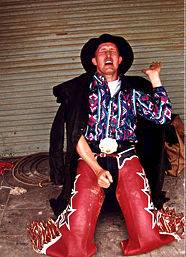
Ride 'em, cowboy:
Getting in the mood before
a rodeo in Plzen.
WHAT IS THIS THING called the Wild West? John Wayne hunting Apaches? A
faded denim jacket from the Don Imus catalog? Those who live there are forced
to separate fact from myth. But in the Czech Republic, the myth remains
untainted by reality. Czech tramps choose among happy clichés-footloose hobo,
Marlboro Man, noble savage, GI Joe-celebrating wide-open America and throwing
out the details. When I tell my new cowboy and Indian friends that I am from
Santa Fe, New Mexico, the heart of Indian country, most of them seem to care
not at all. They are more interested in showing me their new plastic pistol or
horseshoe belt buckle.
Nonetheless, I don my armadillo bolo tie and head to the stark suburban
neighborhood of Vestec u Prahy on the south side of Prague. There, in the
middle of a cornfield, just beyond a row of housing projects, sits a
weather-beaten ghost town called Westec City. Part theme park, part banquet
center, Westec City represents the big-business side of Czech tramping; it
pulls the ethos out of the woods and half-bakes it, hosting western-style
barbecues and rodeos for corporate clients.
Tonight the partyers are from the Czech division of Microsoft. Cowgirls
in cleavage-revealing western garb hand each guest a black cowboy hat and a
mint julep at the door. Black-hatted executives and programmers line Main
Street, a row of buildings labeled Saloon, Undertaker, and Post Office. As the
sun sets behind the neighboring housing blocks, a tinny loudspeaker blasts the
spaghetti-western theme song from The
Good, the Bad, and the Ugly, and shutters creak in the wind.
A heat wave has descended on Central Europe, so I decide to wet my
whistle with a drink in the Westec Saloon, hoping, as I've been promised, that
I'll hear some good live music. Cowboys belly up to the bar, drinking the local
brew. Faded wallpaper, round card tables, and a mounted deer's head make me
feel like I've stepped into a scene from Kenny Rogers's The Gambler. A man in a cowboy hat is standing onstage, singing
sad-sounding country-and-western songs in Czech, accompanied by a boom box.
"What kind of music you got here?" I ask.
"Both kinds," says the barkeep. "Country and
disco."
Through the window, I watch a man practice for the calf-roping event by
tossing his lariat over anybody who passes by. I go outside and introduce
myself. He tells me his name is Jaroslav Krchov, but his cowboy friends call
him Dick. "That's spelled D-y-k," he says. Dyk, 33, has the callused
hands of a cowboy. He sports a tattoo of his horse, Black-and-White, on his
right arm. We arrange to meet the next day at the garage where he works as an
auto mechanic and then drive out to his "ranch" on the outskirts of
Prague.
When I pick him up in my minivan with Hana, Dyk seems a more subdued,
blue-jumpsuited version of the gregarious cowboy I met at Westec City. We wind
through narrow streets on the way to his house, past pubs and parks full of
kids, and I ask him if anything is wrong. "I must tell you," he
blurts. "My ranch is not like your ranches in the U.S. It is a very small
ranch."
Five minutes later we are at the road's end, on a hill overlooking a
busy expressway. "This is home," Dyk says, gesturing to a small,
red-brick bungalow with a vegetable garden for a front yard. Behind it is a
fence made of a few stakes and some twine. Four horses stand in stalls beside a
pasture the size of a putting green.
Dyk walks over to his faithful Black-and-White, who is standing in the
shade of a cherry tree. Wrapping his arms around the horse's neck, he recalls
the first time he saw The Treasure of the
Sierra Madre-the movie that made him, at age 19, a cowboy. Inspired, he
found time apart from his mechanic's job to ride horses at a stable near his
parents' home northwest of Prague and experiment with saddle repair. Over the
next 14 years he built the stable behind his house, converted a delivery truck
into a horse trailer, and began driving to rodeos in the Czech Republic and
Germany. He spends a third of his $388 monthly salary on hay and oats, but his
appearances at Westec City are for love, not money. Once a year he rides in the
Czech Pony Express, in which horsemen race from town to town across the
country, carrying real mail. He looks out across his quarter-acre spread and
tells me that he plans to move his family to a bigger place farther from the
city, with more space to practice his calf-roping and barrel racing. Capitalism
has been good to Dyk and his clan. "It's much easier to be a cowboy these
days," he says. "We no longer have to hide our cowboyness."
WITH MY WORK FINISHED and my pores oozing sausage grease, I find my way
back to the train station at Revnice, where I first entered the Brdy Hills.
It's a Sunday night, and homebound tramps are everywhere, in the train-station
bar, sleeping on benches, strumming guitars, or nuzzling with sweethearts.
Everyone looks half-dead: It's a scene from Night
of the Living Hobos. Tomorrow the tramps will return to their jobs as
clerks, mechanics, psychiatrists, and mayors.
For a brief but glorious time, I've lain myself down in the bohemian
heart of camping. My extreme-sports-loving friends back in the States spend
thousands on high-tech gear and strenuous expeditions that cannot possibly
deliver the degree of comfort I got lying on the ground 20 yards from a pub. At
every step my beer glass was full, my belly had meat, and my cigar was lit.
Soap? Razor? I don't need no stinking razor. I've found the real,
world-preserving wildness celebrated by that Yankee bohemian, Henry David
Thoreau-the wildness not of place, but of what he called "foresters and
outlaws." This is camping: eating junk, getting dirty, misbehaving. I've
gone native: This boy is a tramp.
The train pulls into the station. I climb aboard and once again sprawl
on the floor. As we pull out, the car begins to shake and clank in a satisfying
rhythm. I'm just drifting off to sleep when a man dressed in ripped jeans and a
torn army jacket, accompanied by a mangy dog with a metal muzzle, plops down next
to me. He pulls an envelope full of tobacco out of his pocket and offers to
roll me a cigarette. I decline, but look closer. Though I probably appear
rather disgusting myself, this man looks much worse. He has clearly been on the
road a long time, a lot longer than a couple of weeks. Wait a minute, I
think-here's a real hobo.
He pulls out a stainless steel hip flask and offers me a swig. I take a
long pull and wipe my mouth with the back of my hand.
"Dekuji," I say in thanks.
Realizing from my accent that I'm an American, he sits up, grabs his
guitar, and begins to play: "This land is your land, this land is my land,
from South Moravia to North Bohemia..."
It's time to go home. 
While living the Czech
outdoor life last June, Brad Wetzler gained ten pounds.
(article from
http://www.outsidemag.com/magazine/200011/200011czech1.html)